
When you stroll through an old Scottish graveyard, you might notice strange iron cages covering certain graves. At first glance, they look like something meant to keep the dead from clawing their way out — and in a way, that’s not entirely wrong. These eerie devices are called mortsafes, and their story weaves together real history, crime, and a touch of chilling folklore.
If you’ve ever wandered through an old Scottish graveyard and noticed an odd-looking iron cage covering a grave, you might have stumbled upon a piece of eerie history: the mortsafe. The name alone sounds like something out of a gothic novel, but mortsafes were very real, and they’re tied to a fascinating chapter of folklore and fear in Scotland.
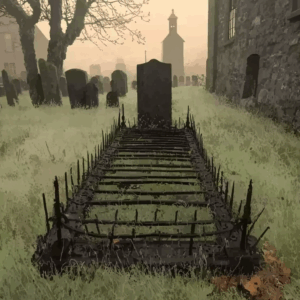 In the late 18th and early 19th centuries, there was a booming black-market trade in corpses. Medical schools were desperate for cadavers to study and dissect, but the law allowed only the bodies of executed criminals to be used. As you can imagine, there weren’t nearly enough of those to go around. Enter the “resurrectionists,” body-snatchers who dug up freshly buried coffins under the cover of night and sold the corpses to anatomy professors. Creepy? Absolutely. Lucrative? Even more so.
Understandably, ordinary families weren’t too keen on the thought of their loved ones being carted off in the back of a wagon for dissection, so they started getting creative with ways to protect the graves. That’s where the mortsafe came in: a heavy iron or stone contraption, usually shaped like a cage, designed to lock over a coffin and keep grave robbers at bay. Some were permanent fixtures, while others were rented out to grieving families until the body had decayed enough to be of no use to medical science. After all, the resurrectionists wanted fresh bodies, not skeletons.
Over time, mortsafes became surrounded by folklore. Some people began to see them not just as protection against body-snatchers, but as a symbolic barrier between the dead and the living. In a way, they fed into old superstitions about restless spirits and the undead. A mortsafe didn’t just keep out the thieves – it kept in whatever might try to rise. For villagers already steeped in tales of witches, ghosts, and revenants, that iron cage offered a little extra peace of mind.
Today, you can still spot mortsafes in certain Scottish churchyards, especially in rural areas. They stand as eerie relics of a time when fear of grave robbing was very real, but also as monuments to the intersection of science, crime, and superstition. Many tourists stumble across them without knowing their backstory and assume they’re some kind of vampire-proofing – and honestly, that explanation doesn’t feel too far-fetched when you see one in person.
What I love about the mortsafe story is how it bridges the gap between practical history and spooky folklore. On one hand, it’s a clever response to a grim social problem. On the other, it taps into timeless human anxieties about death, the sanctity of the grave, and what lies beyond. Next time you’re wandering through a Scottish cemetery and spot an iron cage on a gravesite, pause for a moment. You’re not just looking at metal bars – you’re looking at a story forged from science, crime, and the deep-rooted human fear of what lurks in the dark.